

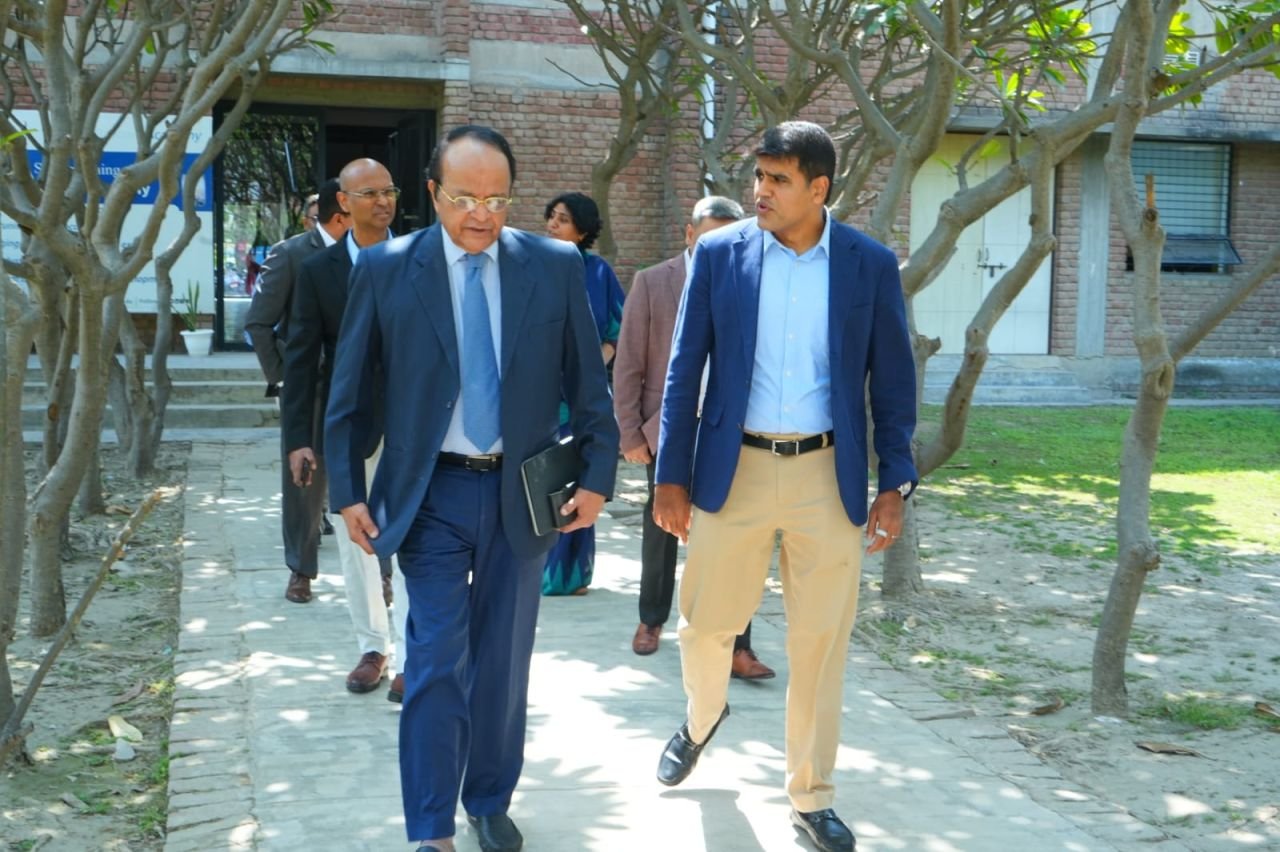
A Conversation with Prof. V. N. Rajasekharan Pillai
The office is unusually quiet.
There are no oversized portraits, no carefully curated display of awards, and no visible attempt to announce a lifetime of achievement. Instead, shelves lined with books on chemistry, higher education, public policy, and philosophy offer a more accurate introduction. The room reflects the man who occupies it: scientist before administrator, institution-builder before public figure.
For more than five decades, Prof. V. N. Rajasekharan Pillai has helped shape the landscape of Indian higher education while maintaining a distinguished career as a researcher and scholar. An internationally recognised Polymer Scientist, he has authored over 200 research publications, supervised more than 67 doctoral and post-doctoral researchers, and mentored generations of scientists across India and Europe.
His leadership journey spans some of India’s most influential academic institutions. He has served as Vice-Chancellor of Mahatma Gandhi University, where he helped transform a young university into a nationally respected institution; Vice-Chancellor of Cochin University of Science and Technology; Vice-Chancellor of IGNOU, the world’s largest open university; President of Mewar University; and Vice-Chancellor of Somaiya Vidyavihar University, where he played a key role in advancing multidisciplinary education aligned with the National Education Policy.
At the national level, he served as Executive Director of NAAC and later as Vice-Chairman and Chairman of the University Grants Commission, helping shape accreditation systems, quality frameworks, and higher education policy across the country. His influence extended internationally through his role on UNESCO’s Drafting Committee for Higher Education Policy. Today, he serves as Chancellor of ICFAI University, Himachal Pradesh, and as Advisor and Professor of Eminence at the Jio Institute.
Yet what makes Prof. Pillai’s story remarkable is not the number of positions he has held. It is his enduring belief that universities are not merely institutions that confer degrees, but places that create knowledge, nurture talent, shape societies, and expand human possibility. In an age of personal brands, his career offers a different lesson: build institutions that outlast individuals.
1. You have spent more than five decades as a researcher, teacher, Chancellor, Vice-Chancellor, regulator, and policy leader. Looking back, what has remained constant in your understanding of the purpose of a university?
When I began my career as a young researcher, I viewed universities primarily as centres of knowledge creation. As a teacher, I saw them as places where minds are shaped. As an academic leader and policymaker, I came to appreciate a larger truth: universities are among society’s most important institutions because they create knowledge, develop talent, preserve values, and enable social mobility.
Too often, universities are judged only by degrees awarded, rankings achieved, placements secured, or research output generated. While these are important indicators, they are not the ultimate purpose. The true role of a university is to help individuals discover their potential and prepare them to contribute meaningfully to society.
Across my journey from Mahatma Gandhi University and Cochin University of Science and Technology to IGNOU, the University Grants Commission, Somaiya Vidyavihar University, and now Jio Institute I have found that the strongest institutions balance excellence with relevance. They advance knowledge while remaining connected to societal needs.
As Artificial Intelligence transforms education and work, universities must continue to cultivate what technology cannot replace: wisdom, judgement, creativity, ethical responsibility, and character. Knowledge may be abundant, but helping students use it responsibly for the greater good remains the enduring purpose of a university.
2. Before becoming one of India’s most influential higher education leaders, you were a scientist deeply engaged in polymer research. How did your experience as a researcher shape the way you later approached institution building and academic leadership?
My years as a researcher profoundly shaped the way I approached academic leadership.
Science teaches two lessons very early: humility and patience. A molecule does not respond to authority or reputation; it responds only to evidence, experimentation, and intellectual rigour. That mindset stayed with me throughout my journey as an educator and institution builder.
As a Polymer Scientist, I learned that meaningful breakthroughs rarely emerge from isolation. They are the product of curiosity, collaboration, persistence, and the freedom to ask difficult questions. Later, while leading universities and national institutions, I realised that great universities evolve in much the same way. They flourish when talented people are given the freedom, support, and environment to pursue excellence.
Research also taught me that the most valuable investment is in people. Guiding doctoral scholars and young researchers reinforced my belief that institutions grow when they nurture future leaders rather than depend on a few individuals.
Most importantly, science taught me to think in decades, not years. Whether at Mahatma Gandhi University, IGNOU, the UGC, Somaiya Vidyavihar University, or Jio Institute, I have viewed leadership as creating the conditions for sustained growth, discovery, and long-term institutional excellence.
3. You have led institutions as different as Mahatma Gandhi University, Cochin University of Science and Technology, IGNOU, Somaiya Vidyavihar University, and national bodies such as NAAC and the UGC. What have these experiences taught you about the difference between managing an institution and building one? Also the difference in managing public and private institutes?
One of the most important lessons I have learned is that management and institution building are fundamentally different. Management focuses on the present budgets, processes, compliance, and daily operations. Institution building focuses on the future. It is about creating a vision, nurturing talent, shaping culture, and building systems that endure beyond any individual leader.
A well-managed institution functions efficiently. A well-built institution develops its own momentum, attracts outstanding faculty and students, and continuously renews itself. Institution building is ultimately about creating an ecosystem rather than administering an organisation. While each institution I worked with faced different challenges, the principle remained the same: build capacity, not dependency. The most successful institutions, regardless of ownership, share common characteristics: academic freedom, strong leadership, a culture of inquiry, commitment to quality, and a clear sense of purpose.
4. Throughout your career, you have worked at the intersection of teaching, research, regulation, and policy. What do you believe India still misunderstands about creating world-class universities?
Buildings can be constructed in a few years. Academic excellence takes decades. Across the world, the universities that have endured as centres of excellence whether Harvard, Oxford, Cambridge, Stanford, MIT, or the National University of Singapore were not built merely through financial investment. They were built through a sustained commitment to academic freedom, research culture, talent development, institutional autonomy, and long-term vision.
In India, we often focus on visible indicators of success: campuses, technology, international partnerships, and rankings. While these are important, they are outcomes rather than causes. The real foundation of a great university lies in its people, its faculty, researchers, students, and leaders and in the intellectual culture they collectively create.
Another misunderstanding is the tendency to expect immediate results. World-class research ecosystems are not built within a political or administrative cycle. They require continuity of purpose across generations. Institutions such as IISc, IITs, and a few leading universities demonstrate what is possible when excellence is nurtured consistently over time.
I also believe we have not fully appreciated the importance of research-led universities. Teaching and research are often viewed separately. In reality, the best teaching emerges from active engagement with discovery and innovation. Students should learn not only established knowledge but also how new knowledge is created. As we enter the AI era, a world-class university will no longer be defined only by disciplinary excellence. It will be defined by its ability to integrate science, technology, social sciences, humanities, ethics, and public policy to solve complex societal challenges.
Ultimately, creating world-class universities is not about replicating global models. It is about building institutions that are globally respected, locally relevant, research-intensive, socially responsive, and intellectually courageous. The question is not whether India has the talent to create such universities. We certainly do. The question is whether we have the patience, trust, and institutional commitment required to sustain them over the long term.
5. Having interacted with students across multiple generations from the 1970s to the AI era, what changes have you observed in young learners, and what qualities do you believe will remain timeless regardless of technological change?
The students I taught in the 1970s entered a world where knowledge was scarce and access was limited. Information resided in libraries, journals, and classrooms. Learning required patience. Today’s students inhabit a completely different universe, one where information is abundant, accessible instantly, and increasingly generated by intelligent machines.
What has changed most dramatically is the relationship between learners and knowledge. Earlier generations spent considerable effort finding information. Today’s challenge is filtering, evaluating, and making sense of an overwhelming volume of information.
I also find that young people today are far more globally aware, technologically fluent, and open to interdisciplinary thinking. They are less constrained by traditional career pathways and more willing to question established assumptions. This is a positive development. Innovation often begins with questioning.
At the same time, they face pressures that previous generations did not encounter. The pace of change is relentless. The digital world creates constant comparison, shorter attention spans, and uncertainty about the future. Many students are preparing for professions that may not yet exist, and many fear they are preparing for ones that might become redundant in the near future.
Yet across all these decades, I have found that certain qualities remain unchanged. Curiosity remains the foundation of learning. Integrity remains the foundation of trust. Discipline, resilience, empathy, and the willingness to work hard continue to distinguish exceptional individuals from merely successful ones. Artificial Intelligence may transform how we learn, work, and create. But it cannot replace wisdom, ethical judgement, compassion, or the human capacity to find meaning and purpose.
The universities that succeed in the future will be those that prepare students not only for the jobs of tomorrow, but also for the responsibilities of being thoughtful, ethical, and engaged citizens in a rapidly changing world.
6. We live in a time when visibility often receives more attention than institution building. What does leadership mean to you in an age of personal brands, rankings, and constant public attention?
A leader’s true legacy is not what he builds for himself, but what continues to thrive after he has left.
The most important work in higher education is often invisible. Building academic cultures, strengthening governance systems, mentoring young faculty, creating research ecosystems, and establishing institutional values rarely generate headlines. Yet these are the foundations upon which great universities are built.
Throughout my career, whether at universities, regulatory bodies, or national institutions, I have learned that sustainable change requires patience. Institutions are not transformed through announcements; they are transformed through consistent effort over many years. The finest leaders are often those who create conditions for others to succeed rather than constantly placing themselves at the centre of the narrative.
Rankings are useful indicators, but they are not the purpose of a university. Reputation is an outcome, not a strategy. When institutions focus excessively on visibility, they risk prioritising appearance over substance. When they focus on excellence, credibility follows naturally.
7. Artificial Intelligence, interdisciplinary learning, digital public infrastructure, and lifelong education are reshaping higher education globally. Where do you see the next great transformation in universities, and how should institutions prepare for it?
The next great transformation in higher education will not be technological alone; it will be structural and philosophical.
For centuries, universities have been organised around disciplines, degrees, and fixed periods of study. The future university will be organised around problems, competencies, and lifelong learning. The boundaries between engineering, medicine, social sciences, business, and humanities will continue to blur because the challenges facing society, climate change, public health, sustainable development, artificial intelligence, and social equity cannot be solved within disciplinary silos.
Artificial Intelligence will accelerate this transformation. Universities will increasingly move from being primary providers of information to becoming curators of learning, critical thinking, and ethical reasoning. Knowledge will be abundant; wisdom will become the differentiator.
I also foresee the rise of highly personalised learning pathways enabled by AI, where learners can acquire competencies throughout their lives rather than during a single phase of education. The distinction between campus learning, workplace learning, and online learning will gradually disappear.
For institutions, the challenge is clear. They must invest in interdisciplinary research, strengthen digital infrastructure, build global partnerships, and develop flexible curricula that evolve with emerging knowledge. Equally important, they must preserve what technology cannot replace human mentorship, ethical reflection, creativity, and social responsibility.
8. When future generations look back on your work, what do you hope will endure beyond the positions you held?
Positions are temporary. Institutions endure. Ideas endure even longer. When I look back on my own journey, I do not measure it by the offices I occupied or the titles I held. Those were responsibilities entrusted to me for a period of time. What matters more is whether the institutions became stronger, more inclusive, and more capable of serving future generations.
If there is one idea I would like to endure, it is the belief that universities are among society’s most important public institutions. Their purpose extends far beyond awarding degrees. They create knowledge, nurture talent, encourage critical inquiry, preserve culture, and expand human possibility. I would like to be remembered not for the positions I held, but for the institutions I helped strengthen and the possibilities I helped create for others.





2 Responses