
There is a strange confidence in modern education.
We believe we know what the future requires. We tell children to learn coding, data, finance, robotics, public speaking, design, entrepreneurship, foreign languages, research, communication and problem-solving. We tell universities to produce job-ready graduates. We tell schools to prepare students for a world of artificial intelligence, climate instability, shifting borders and careers that may not yet exist.
None of this is wrong. But it is incomplete.
A student may be employable and still be unable to act with judgement. A professional may be brilliant and still be careless with people. A leader may be technically competent and still corrode trust. A society may become more educated and still become less humane.
That is the gap the old Indian distinction between Apara Vidya and Para Vidya helps us name.
In the Mundaka Upanishad, knowledge is described in two forms: a lower or worldly knowledge, and a higher knowledge by which the deeper truth is known. For a modern reader, this need not be treated only as a spiritual classification. It can be read as an educational warning.
Apara Vidya teaches us how to function in the world.
Para Vidya teaches us how not to lose ourselves in it.
One builds competence. The other builds conscience.
The question is no longer whether both are desirable. The question is whether any serious education system can survive without holding them together.
The future is asking for more than skill
The future of work is often used as the strongest argument for skill-first education. The logic is simple: jobs are changing, technology is accelerating, and students must be prepared.
The World Economic Forum estimates in its Future of Jobs Report 2025 that structural labour-market change could affect 22 percent of today’s total jobs by 2030, with 170 million new jobs created and 92 million displaced. The same report notes that the fastest-growing skill areas include AI, big data and cybersecurity, but also stresses the continuing importance of human skills such as analytical thinking, resilience, flexibility, leadership and collaboration.
This is where the debate becomes interesting. Even the most future-facing labour-market report is not saying that technical skill alone will be enough. It is saying the opposite. The worker of the future will need to use tools, but also interpret consequences. Collaborate across difference. Stay steady through uncertainty. Learn, unlearn and relearn without becoming brittle.
Apara Vidya may help a student get the job. Para Vidya may determine what kind of person they become once they have power, money, visibility or influence.
The future will not be short of people who can produce. It may be short of people who can pause.
Education as a public good, not only a private ladder
For decades, education has been sold as a ladder. Study hard. Score well. Enter the right institution. Get the right job. Move up.
For millions of families, especially in countries like India, this ladder is real and necessary. Education has been the route to dignity, mobility and self-respect. To dismiss that aspiration would be unfair.
But a ladder is still a narrow metaphor. It treats education as private advancement. One person climbs. One family rises. One career is secured.
UNESCO’s work on renewing the social contract for education asks for a broader imagination. It frames education as a public and common good, grounded in the right to education throughout life, and links learning to justice, cooperation, sustainability and the transformative power of knowledge.
That phrase, common good, changes the frame. It asks us to evaluate education not only by what it does for the individual, but by what kind of society it makes possible.
Does education produce citizens who can disagree without hatred? Does it produce professionals who can use technology without surrendering judgement? Does it produce leaders who understand the cost of decisions on invisible people? Does it produce human beings who know how to live with freedom and restraint?
This is where Apara and Para meet.
Apara Vidya helps the student move forward. Para Vidya asks whether, in moving forward, the student becomes more awake to the world around them.
Case Study 1: Singapore and the seriousness of character
Singapore is often discussed as a high-performing education system. It is associated with rigour, standards, meritocracy and strong academic outcomes. But one of the more revealing parts of its educational design is the seriousness with which it treats character and citizenship.

Singapore’s Ministry of Education frames its 21st Century Competencies around core values such as respect, responsibility, resilience, integrity, care and harmony. Its Character and Citizenship Education is intended to nurture values and social-emotional competencies so students grow into morally grounded, active and contributing citizens.
The lesson from Singapore is not that values can be neatly programmed into children. That would be too simple. The lesson is that a modern, economically competitive country has recognised that capability without character is an incomplete national asset.
This matters because values education is often dismissed as vague. Singapore’s example shows that character can sit inside a serious national curriculum conversation without abandoning excellence. A student who learns respect is not becoming less competitive. A student who learns resilience is not becoming less ambitious. A student who learns responsibility is not being distracted from the future. They are being prepared for it.
Case Study 2: Finland and learning across boundaries
Finland offers another modern lesson. Its national core curriculum includes transversal competences and requires at least one multidisciplinary learning module each year, allowing schools to combine different subjects around broader themes and local contexts. At the upper-secondary level, the Finnish National Agency for Education frames transversal competence through areas such as well-being, interaction, multidisciplinary and creative competence, societal competence, ethical and environmental competence, and global and cultural competence.

The important point is not simply that Finland encourages interdisciplinarity. Many countries now do that in language. The deeper lesson is that the world itself does not arrive in subject periods.
Climate change is not only science. It is economics, ethics, politics, migration, agriculture, health and intergenerational responsibility. Artificial intelligence is not only technology. It is labour, bias, attention, law, creativity and power. Public health is not only medicine. It is trust, behaviour, infrastructure, inequality and communication.
Apara Vidya gives students the disciplines.
Para Vidya teaches them to see relationship.
A child can learn biology and still not understand ecological responsibility. A student can learn economics and still not understand human cost. A coder can learn optimisation and still not ask who is being optimised out.
Finland’s transversal approach reminds us that education must train students not only to know parts, but to understand systems. That may be one of the defining abilities of the next generation: to see how things connect before the damage becomes irreversible.
Case Study 3: One World One Family and education as lived infrastructure
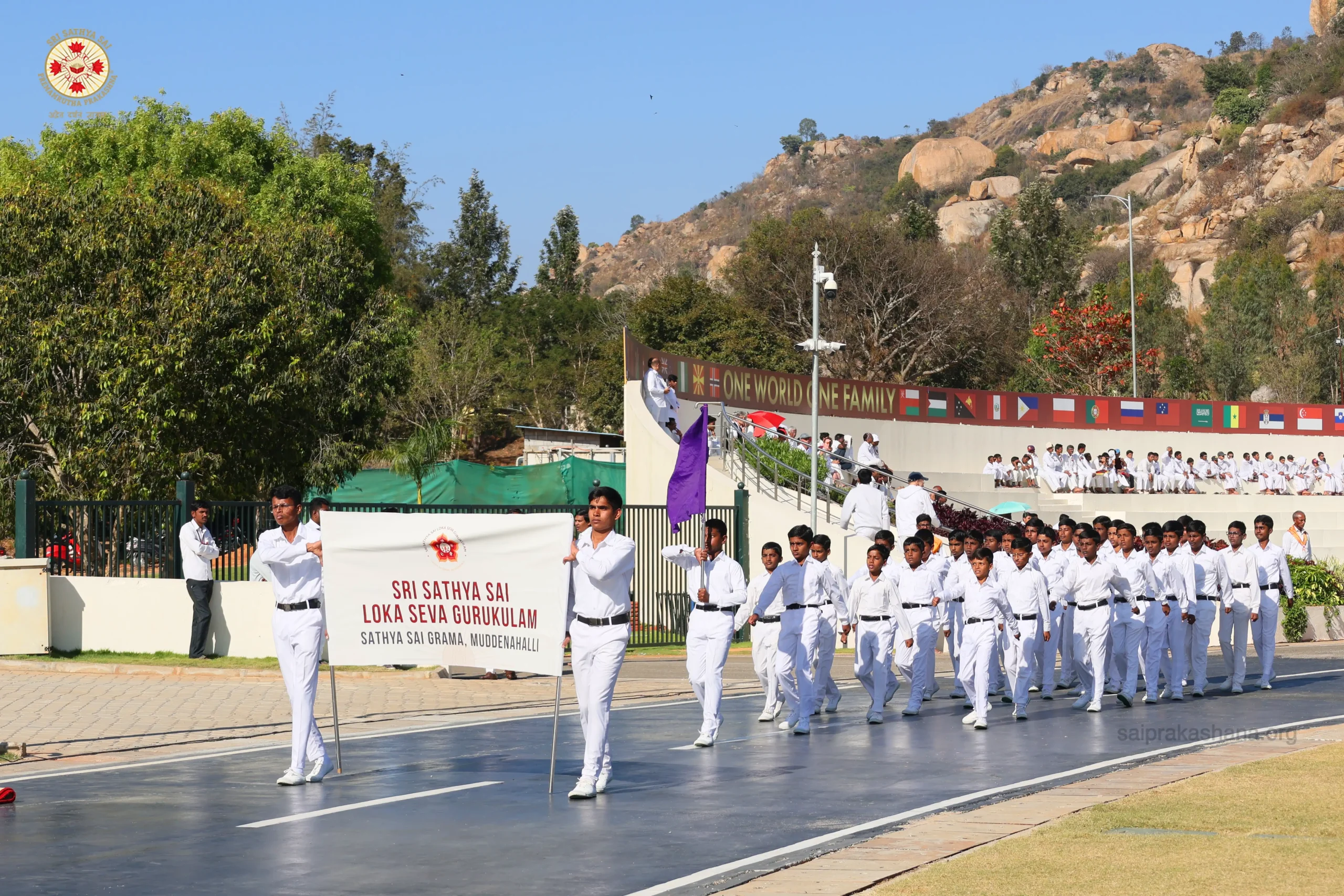
A third example comes from the One World One Family education ecosystem, where the idea of Apara Vidya and Para Vidya is not treated as a philosophical contrast alone, but as an institutional design principle.
Across its 27 residential school campuses, the model gives equal weightage to academic education, or education for a living, and human values education, or education for life. The same emphasis reportedly continues into higher education through SSSUHE, which offers higher education across multiple fields, including medical education, without charging students.
What makes this example relevant is not scale alone. It is the attempt to build values into the structure of education rather than leave them as occasional lessons. The use of a Humaneness Quotient, or HuQ, to assess qualities such as empathy, integrity, responsibility, equity, diversity and inclusivity is one such attempt to make character part of institutional life.
This does not mean every institution must replicate the model. The more useful question is what it reveals: that Para Vidya cannot survive as an assembly speech or a moral science chapter. It has to be carried by systems, teachers, assessment, daily conduct and the culture of the campus.
Apara Vidya gives students the ability to build a life.
Para Vidya asks what kind of life they are being prepared to build.
The measurable and the meaningful
One reason Para Vidya is neglected is that it resists easy measurement. Marks are countable. Rankings are visible. Salaries can be tracked. University placements make good brochures. A child’s integrity, courage, empathy or steadiness is harder to display on a dashboard.
But hard to measure does not mean marginal.
The OECD Learning Compass 2030 frames future-ready education around student agency, student well-being, and the knowledge, skills, attitudes and values students need to thrive. The OECD Survey on Social and Emotional Skills 2023 reports that students’ social and emotional skills are linked to life outcomes including academic success, life satisfaction, healthier behaviours, lower test and class anxiety, and more ambitious career plans.
This should not be misread as a productivity argument for kindness. The point is not that empathy is useful because it improves performance. The point is that performance itself is incomplete if it destroys the person performing.
The modern student is under extraordinary pressure to be constantly optimised. Better marks, better profiles, better internships, better networks, better applications, better visibility. Even rest has become strategic. Even hobbies are packaged into achievement. Against this, Para Vidya asks an inconvenient question: what remains of the person beneath the profile?
The teacher in the age of AI
The age of artificial intelligence makes this even more urgent.
If information is abundant, the teacher cannot remain only a transmitter of information. AI can explain, summarise, translate, quiz, draft and personalise. It can be useful in astonishing ways. But the teacher’s deepest role was never only content delivery.
A teacher notices.
A teacher notices the student who has stopped trying because failure has become too humiliating. The child who knows the answer but will not speak. The teenager whose arrogance is covering fear. The gifted student who is becoming unkind. The quiet one who needs one adult to say, “Your voice matters.”
This is the part technology cannot fully replace. It can assist the classroom, but it cannot become the moral climate of the classroom.
That climate is created by how a teacher responds to error. How a school treats disagreement. How authority behaves when it is challenged. How the institution treats the weakest child, not only the brightest one.
Apara Vidya can be delivered.
Para Vidya has to be embodied.
The twist: values are not a subject
The easy solution is to add a values class.
The harder solution is to build values into the life of the institution.
If students are taught empathy but humiliated for asking slow questions, they learn humiliation. If they are taught integrity but see cheating rewarded, they learn performance. If they are taught inclusion but only toppers are celebrated, they learn hierarchy. If they are taught environmental responsibility but the campus wastes without thought, they learn contradiction.
Values are not absorbed from slogans. They are absorbed from systems.
This is why the Apara-Para framework feels surprisingly modern. It does not ask education to become less rigorous. It asks rigour to become more whole.
A medical student must learn anatomy, diagnosis and treatment. But she must also learn how to sit with suffering. An engineering student must learn systems, design and computation. But he must also learn consequence. A business student must learn markets, growth and capital. But she must also learn trust. A law student must learn procedure and precedent. But he must also learn justice. A teacher must know the subject. But she must also know how children become themselves.
Apara without Para makes ability dangerous. Para without Apara makes goodness ineffective. The future needs both.
A new international definition of success
The most interesting education systems of the future will not be those that choose between excellence and humanity. They will be the ones that refuse the split.
Singapore shows that character can sit inside a high-performance national education conversation. Finland shows that competence must move across disciplines if students are to understand the world as it actually functions. UNESCO and OECD both point, in different languages, towards education as something larger than employability.
This is the international case for an old Indian idea.
Apara Vidya prepares the student to enter the world.
Para Vidya prepares the student to improve it.
That distinction matters because the final examination of education is not the entrance test, the board result, the university admit or the first salary. Those are milestones. Important ones, but milestones still.
The final examination is what a person does with capacity.
Do they use knowledge to dominate or to serve? Do they use intelligence to manipulate or to understand? Do they use success to separate or to build? Do they use freedom only for themselves, or also to widen possibility for others?
These are not old-fashioned questions. They are the questions of the AI age, the climate age, the loneliness age, the polarised age.
From human being to being human
A human being is a biological fact. Being human is an acquired discipline.
That discipline cannot be left to chance. It has to be designed into homes, schools, universities, workplaces and public life. It has to be practised through listening, service, restraint, courage, truthfulness and responsibility. It has to be modelled by adults before it can be expected from children.
The world already has powerful machines, ambitious markets, restless economies and endless information. What it still needs is guided human beings.
That is the modern meaning of Apara and Para.
Education for a living cannot be separated from education for life. Because the question before the world is not only whether we can build a more advanced civilisation.
It is whether we can build one that still deserves to be called human.


One Response