
Part Three of Three Parts | Also read Part One & Part Two
Part Two of this series ended with a practical question: how can intensely personal spiritual convictions produce institutions that are visible, measurable and public? Part Three asks the question in reverse. What does the act of serving do to the person who serves?
Within the One World One Family mission, the answer is explicitly spiritual. Nutrition, healthcare and education are not described only as charitable outcomes. They are also presented as ways of weakening the sense of separation between “self” and “other”. The mission’s own public description places “inner transformation” at the heart of its work and describes its path as rooted in Vedanta, selfless service and the practice of human values.
For the mission’s current articulation of this service-spirituality model, see the Sri Madhusudan Sai mission overview.
That is a more demanding claim than philanthropy. It says the beneficiary is not the only person meant to change.
The years the movement describes as a test
Seshadri describes the years after 2011 as a period of intense pressure for Madhusudan Naidu and the small group around him. Their central claim that Sri Sathya Sai Baba continued to guide the work after his physical death was bound to invite scepticism and opposition. Devotee accounts also describe Madhusudan’s own life during this period as one of financial strain, loss of ordinary social supports and progressive renunciation.
These are largely insider recollections and are best read as such. Their importance is not that an outside publication can independently establish every detail, but that they reveal how the community understands spiritual formation: not as an escape from difficulty, but as the gradual stripping away of attachment, status and ego.
Guru Purnima 2019 is treated within the movement as a turning point. From this period, Madhusudan increasingly came to be addressed as Sadguru Sri Madhusudan Sai. Devotee narratives use much stronger language: “ascension”, Self-realisation and jivanmukti, or liberation while living, to describe the change. Those are theological claims rather than empirically testable ones. What can be observed is that his public role changed from that of a communicator within the post-2011 movement to that of its principal spiritual teacher and institutional leader.
What “Self-realisation” means in this vocabulary
To understand the argument, it helps to separate the word from the halo that often surrounds it. In Vedantic thought, the ordinary personality, body, senses, mind, emotions and intellect are not regarded as the deepest identity. Traditional teaching often speaks of five koshas, or sheaths, ranging from the physical to increasingly subtle layers of experience. Behind them is Atman: consciousness itself.
The point is not merely to learn this as a proposition. The claim is that one can experience a shift in identity: from “I am this changing body-mind” to an awareness that is not exhausted by those changes. Seshadri uses a familiar metaphor. Life is the movie; consciousness is the screen. The film can be joyful, frightening or tragic, while the screen on which it appears remains untouched.
Readers may approach this literally, psychologically, philosophically or not at all. What matters for understanding the mission is the ethical consequence its practitioners draw from the idea. If the same consciousness is present in all beings, then another person’s suffering is not entirely somebody else’s problem.
Why bread comes before metaphysics
Here the spiritual argument returns quickly to material life. A person who is hungry, seriously ill or denied education has far less freedom to pursue any larger question about the Self. Seshadri therefore treats food, healthcare and education not as distractions from spirituality but as preconditions for human possibility.
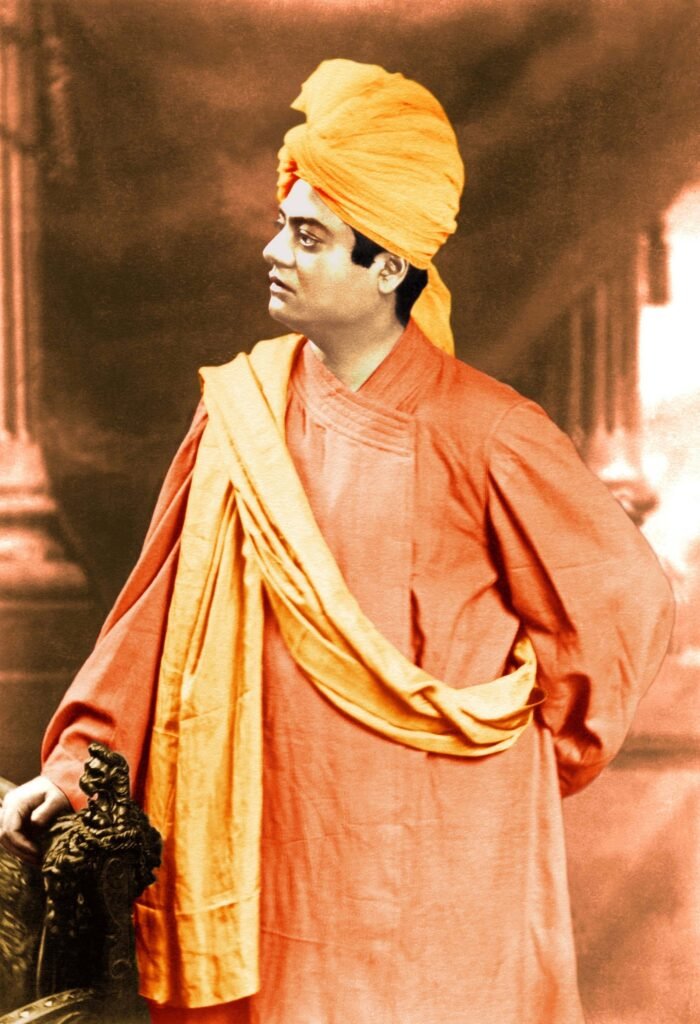
There is a clear historical precedent for this reasoning in the Ramakrishna-Vivekananda tradition. The Ramakrishna Mission describes service as “Vedanta in practice” and preserves the ideal that one’s own liberation and the welfare of the world belong together. Its own account of service recalls Sri Ramakrishna’s insistence that an empty stomach is no good for religion and Swami Vivekananda’s expansion of that principle into organised social service.
For that historical philosophy of service, see the Ramakrishna Math and Ramakrishna Mission account of service.
That lineage matters because Madiyal Narayan Bhat, whose work formed the historical foundation of Sathya Sai Grama, drew heavily from Vivekananda. In Seshadri’s account, Bhat adopted the Ramakrishna Mission motto, Atmano mokshartham jagat hitaya cha, for one’s own liberation and for the welfare of the world, for the Loka Seva Vrinda as well.
From seva and sadhana to “Prema Yoga”
Sri Sathya Sai Baba used another paired formulation: seva and sadhana — selfless service and spiritual practice. The two were not meant to occupy separate compartments. Service was itself a discipline, provided it was not driven by ego, recognition or superiority.
Seshadri sees Madhusudan Sai’s teaching as a contemporary extension of the same idea. The term she uses is “Prema Yoga”, the path of love. Its central premise is non-dual: to see oneself as separate from others is the error; to act from a felt sense of oneness is the correction. In practical language, that means giving more than one takes, forgiving more readily, and learning to reduce the psychological importance of possession and status.
One of the teaching devices attributed to Madhusudan Sai places people along a spectrum: those who take more than they give; those who try to balance the two; those who give more than they take; and, finally, those who live predominantly to give. The categories are spiritual shorthand, but they make the ethical direction unmistakable: the measure of inner growth is not what one accumulates, but how much of the self can be placed at the service of something larger.
Can spirituality scale without becoming bureaucracy?
This is where the One World One Family experiment becomes particularly interesting. Much spiritual service in India has historically grown through monasteries, ashrams, trusts and local networks. The contemporary mission adds another layer: professional management. Hospitals, medical colleges, school systems, nutrition programmes and international partnerships require budgets, governance, staffing, measurement and logistics. Compassion may provide the motive; systems determine whether it reaches anyone reliably.
The result is a model in which modern organisational machinery is not treated as the opposite of spiritual life but as one of its instruments. A hospital that does not bill its patients still needs clinical protocols. A school that wants to teach values still needs teachers, timetables, assessments and buildings. The tension between ideal and administration does not disappear; it becomes part of the work.
Values education as the long game
Part Three of Seshadri’s argument ultimately lands on education. If service is meant to change not only conditions but consciousness, then institutions cannot stop at academic competence. They have to ask what kind of person education is trying to produce.
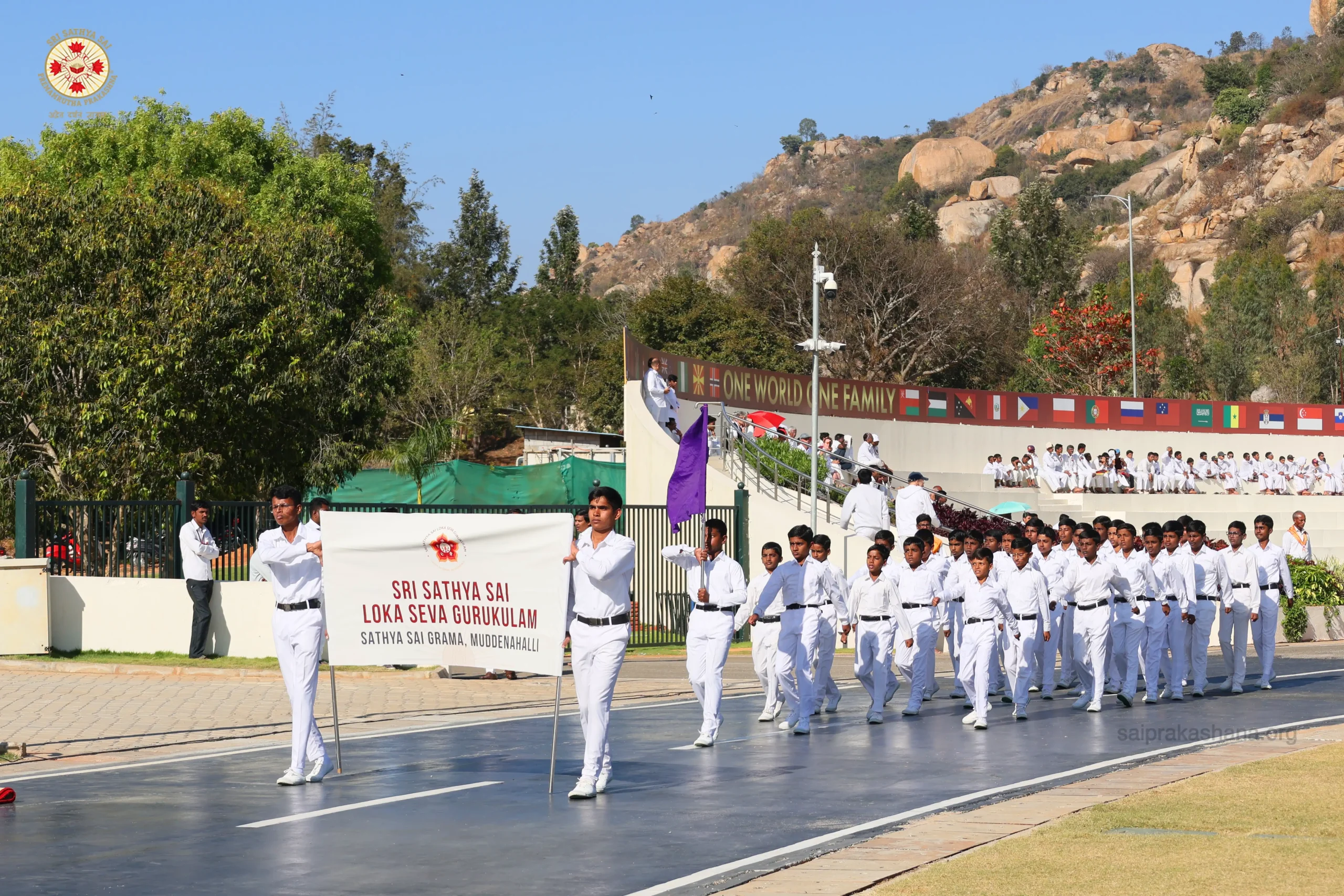
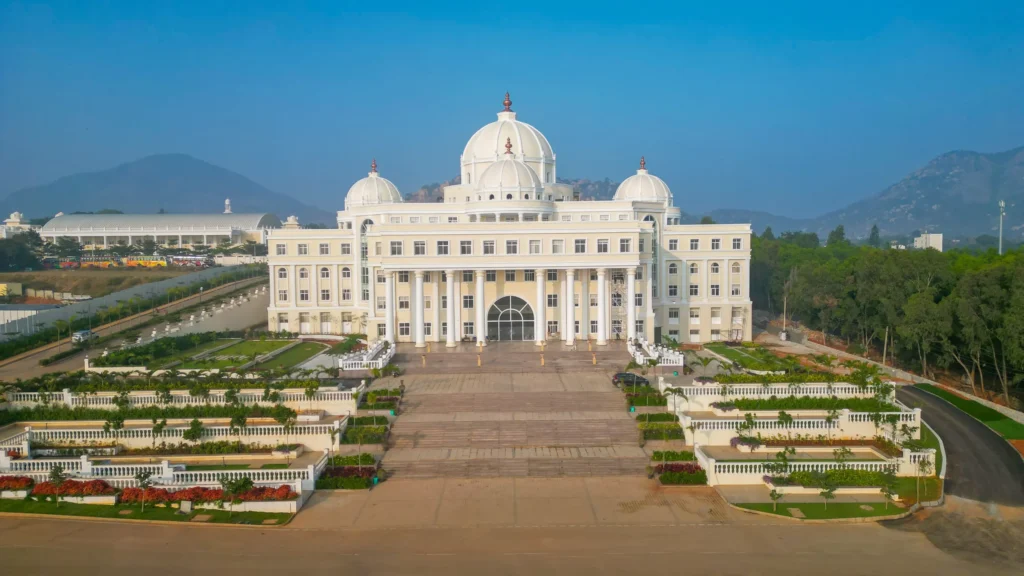
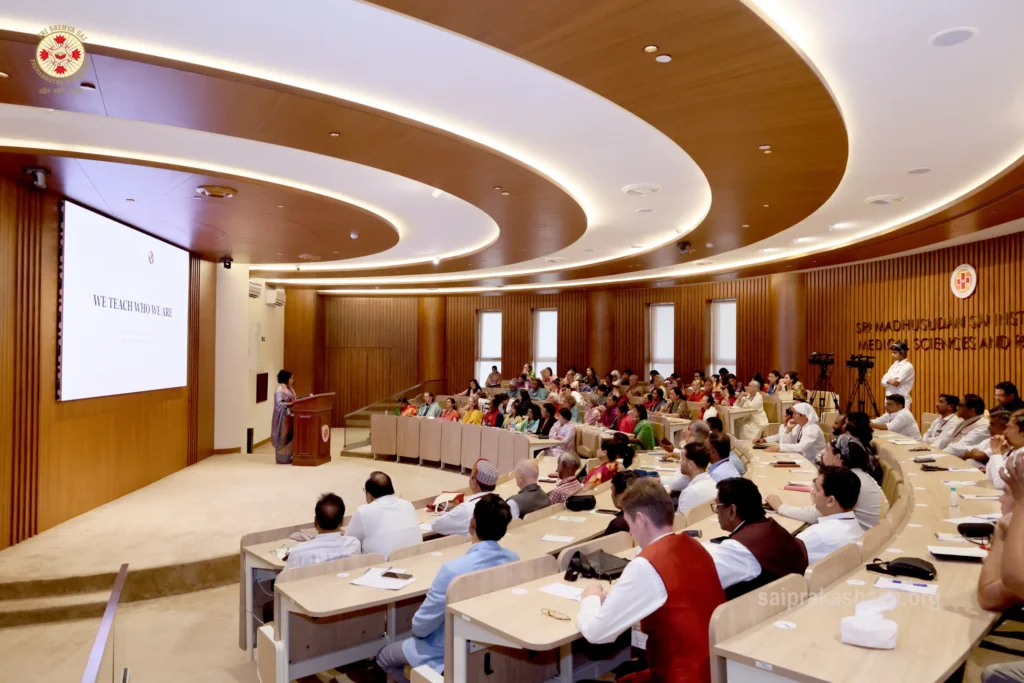
This is no longer just an abstract aspiration within the mission. In July 2026, the International Conference on Values Education at Sri Sathya Sai University for Human Excellence brought together participants from 32 countries and 19 universities. The programme discussed character, emotional intelligence, teacher development, humane assessment and ways of embedding values in education without leaving them as slogans on classroom walls. The university also uses a “Humane Quotient” alongside conventional academic measures, according to the conference account.
The conference is documented in the mission’s 2026 values-education report.
Seshadri uses the older Sanskrit distinction between para vidya and ordinary academic knowledge to describe this ambition: education should address not only what students know, but how they understand themselves and their relationship to others. A plural classroom may use different language, character, ethics, social-emotional learning, citizenship and meaning, but the educational question is recognisable far beyond a religious setting.
The question a secular reader is entitled to ask
There is, however, a genuine question here. Values education can form character; it can also become doctrinal if it is not handled with intellectual openness. A service movement can cultivate humility; it can also create moral certainty about those who serve and those who are served. Any institution that links education and spirituality therefore has to protect room for doubt, disagreement and the dignity of students who do not share the same metaphysical assumptions.
That does not make the project incoherent. It makes the standard higher. If “oneness” is the principle, pluralism cannot be merely tolerated; it has to be lived. If service is the practice, beneficiaries cannot become props in a story about the giver’s virtue. And if education is meant to produce freer human beings, its values must survive questioning rather than depend on insulation from it. There is, however, a genuine question here. Values education can form character; it can also become doctrinal if it is not handled with intellectual openness. A service movement can cultivate humility; it can also create moral certainty about those who serve and those who are served. Any institution that links education and spirituality therefore has to protect room for doubt, disagreement and the dignity of students who do not share the same metaphysical assumptions.
That does not make the project incoherent. It makes the standard higher. If “oneness” is the principle, pluralism cannot be merely tolerated; it has to be lived. If service is the practice, beneficiaries cannot become props in a story about the giver’s virtue. And if education is meant to produce freer human beings, its values must survive questioning rather than depend on insulation from it.
What Gen Z actually inherits
Seshadri’s original conclusion is addressed directly to Gen Z and Gen Alpha. Her hope is explicitly Sanatana Dharmic: that younger people learn to see the divine, or at least the same fundamental worth, in one another and organise their lives accordingly.
A reader does not have to accept every metaphysical premise in this three-part story to recognise the challenge underneath it. Contemporary education is extraordinarily good at teaching young people how to compete, specialise and optimise. It is less consistent at teaching them what success is for, what obligation accompanies privilege, or how to build a life in which another person’s welfare is not permanently external to one’s own.
The One World One Family mission offers one answer: combine competence with service, and service with an inner discipline that steadily reduces the importance of the isolated self. Its vocabulary is Vedantic. Its institutions are modern. Its most provocative proposition is that the two need not be enemies.
Perhaps that is the thread connecting all three parts of this story. “Love as infrastructure” is not only the claim that compassion can build hospitals, schools and nutrition systems. It is the harder claim that institutions, when built around service, can also build people.