

Part One of Three Parts | Also read Part Two & Part Three
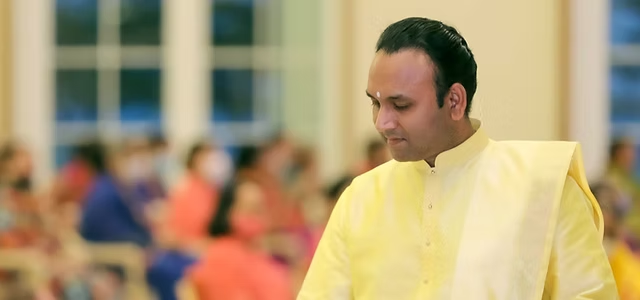
Sadguru Sri Madhusudan Sai is only 47 years old. An MBA and Gold Medallist from Bhagawan Sri Sathya Sai Baba’s business school, he is an ex-banker turned renunciate who, over the past 15 years, has spearheaded an extraordinary global mission of love and service for the underserved.
To look at him only as a spiritual leader would be to miss part of the story. To look at him only as a social reformer would be equally incomplete. What he represents, especially to those trying to understand him through modern lenses, is something rarer: a model of leadership where love is not sentiment, but infrastructure.
At the One World One Family mission that he heads, all services are provided free of charge to beneficiaries. The scale, by any standard, is striking. The mission says it has touched more than 15 million lives, and counting.
For the uninitiated, the numbers can seem almost impossible. What began as Breakfast Seva for 50 government school children in 2012 has grown into one of India’s largest morning nutrition programmes, serving more than 10 million children every day. Its core message is simple and urgent: let no child go to school hungry, ever.
But nutrition is only one part of the work.
The mission’s healthcare initiatives include a large chain of free tertiary-care paediatric cardiac hospitals, multi-speciality hospitals, mother-and-child hospitals, more than 100 primary-care wellness centres, a growing healthcare-on-wheels programme, and a private rural residential medical college where education is provided free of charge.
In education, 27-plus rural residential school campuses provide values-based education free of charge to thousands of children from marginalised backgrounds. The Sri Sathya Sai University for Human Excellence also offers values-based higher education without fees, with special attention to girls’ education.
The mission’s global education movement, “Let’s Value-Educate the World”, is now being advanced through a “Value Educate the Educators” programme. At a time when education across the world is often measured by rankings, placements and skills, this emphasis on values brings us back to a deeper question explored in Knobles earlier: education for life, not only employability.
When service becomes a system
The One World One Family mission also nurtures Veda and Nada. At the Veda Gurukulam, students learn not only the Vedas but also English, computers, mathematics and general knowledge. At the Nada Gurukulam of SSSUHE, a 200-member symphony orchestra has been created, described as India’s largest, along with training in classical Indian music and dance.
The university also offers placement services within the institutions of the mission. So inspired are many students by Sadguru Sai that, according to the mission, nearly all graduates opt to join back in some capacity.
Scholarships are offered in collaboration with Seva Bharathi to more than 10,000 children from socio-economically challenged backgrounds.
Another remarkable initiative concerns farmers. The mission has sought to place Indian farmers, long repositories of traditional agricultural knowledge, in the knowledge economy rather than leaving them in the labour economy alone. Through SSSUHE, a farmer certification initiative was launched. After a rigorous examination, successful farmer-candidates were certified and received “Krishi Rishi” diplomas during the University’s Convocation 2026. This question, who gets recognised as an expert, is also at the heart of the Knobles article Those Who Read the Earth.
The mission has also attempted to address the migration of rural Indian youth to cities through its Rural Shores initiative. This arm of the One World One Family mission upskills, trains, mentors and employs rural youth in rural business-processing offices. Inspired by Bhagawan Baba, Rural Shores is said to have positively impacted, directly or indirectly, more than a million lives across rural India.
In the United States, and now expanding to Mexico, its twin enterprise, People Shores, trains and provides employment in the IT and AI sectors to marginalised youth, particularly African-American communities. Over a dozen Centres for Human Development across the world enable young people to study the spiritual traditions of mankind and participate in selfless service.
At a time when wars, mistrust and fragmentation threaten the human future, the One World One Family mission offers its own response: actionable compassion. Sadguru Sai has often said, in effect, that as a world-family we may have differences of opinion and we may quarrel, as families often do. But we cannot abandon one another. We must continue to care for one another, because we are family.
This is where the mission’s spiritual proposition becomes an institutional one. It is not merely asking people to believe in oneness. It is attempting to build systems that behave as if oneness were true.
The leadership puzzle
The Prashanthi Balamandira Trust of the One World One Family mission has been accorded consultative status with the United Nations Economic and Social Council since 2023. In 2024, it was listed on the Social Stock Exchange of India.
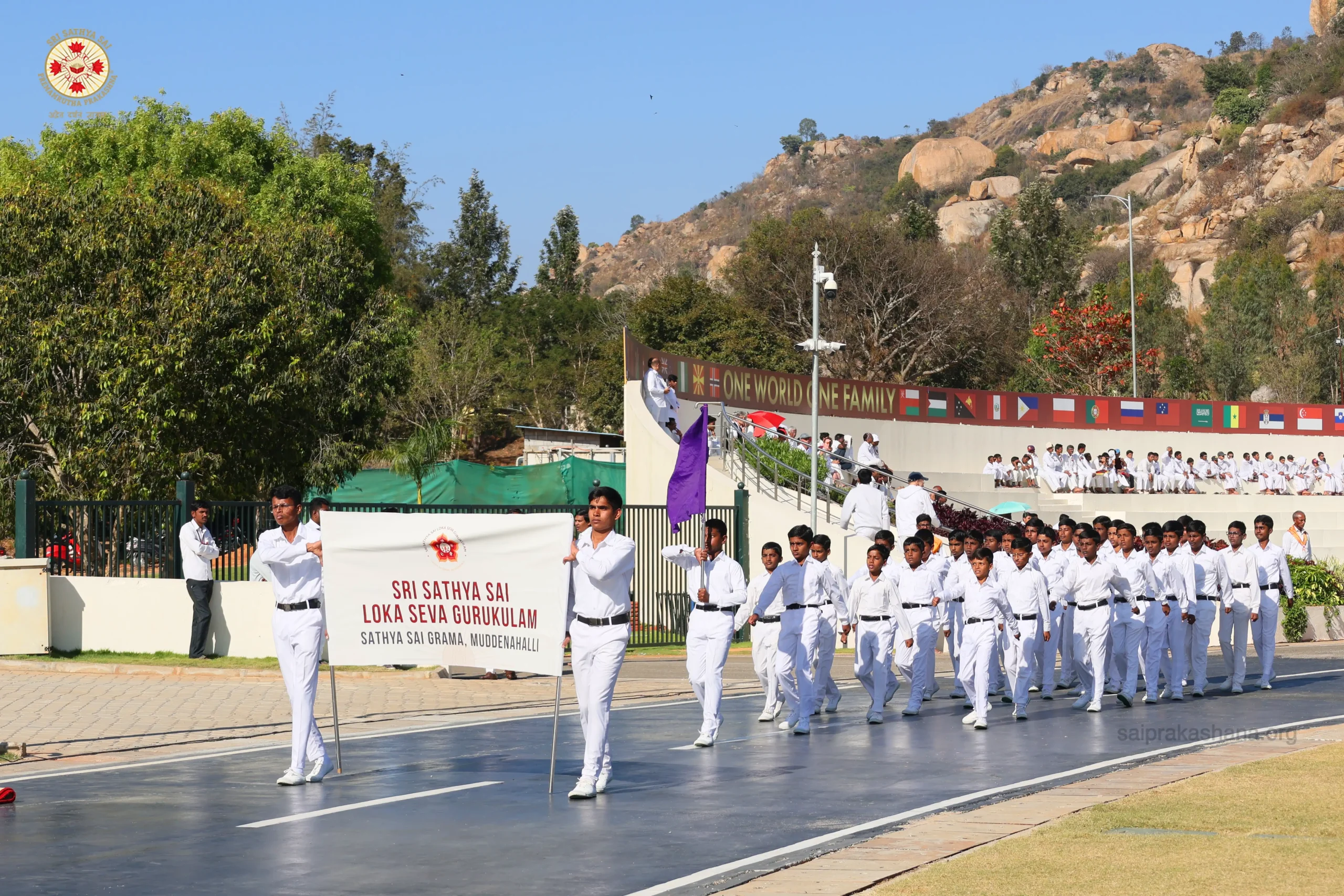
The mission is headquartered in Sathya Sai Grama, a hamlet in Muddenahalli village, Karnataka, about an hour from Bengaluru airport. Supported by volunteers across more than 100 countries, it is financed by a conglomeration of around 70 non-profit foundations in different parts of the world.
Its core teams are lean, and many consist of executives who have left senior corporate roles. Some, like Sadguru Sai, are alumni of Bhagawan Baba’s educational institutions. Some are devotees. Others are regular professionals and volunteers drawn to the mission by its idealism and the visible scale of its work. All, however, appear to have made a difficult choice: to step away from the rat race and seek fulfilment in service. This is the leadership puzzle that modern institutions may find worth studying.
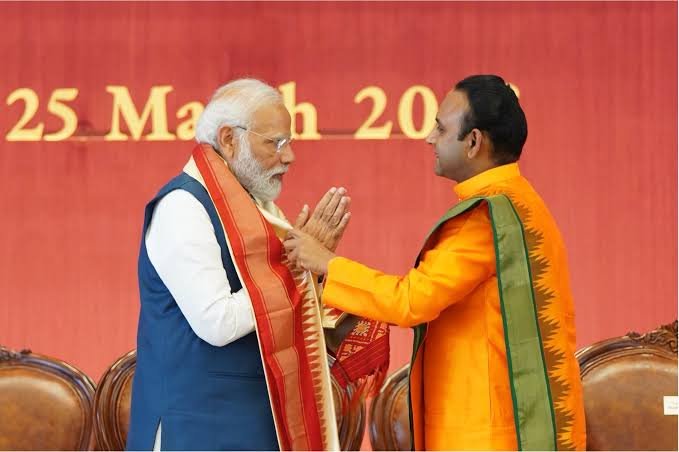
How does a mission scale so quickly across countries, sectors and beneficiaries? How does it attract professionals, volunteers, donors, doctors, teachers and young people from different backgrounds? How does it continue to operate free of charge in areas where even well-funded systems struggle?
Hard-boiled business leaders may look first at structure, execution, governance, funding and strategy. These are necessary lenses. But those who are drawn to the mission insist that its deeper operating principle is selfless love.
For a material world trained to think in terms of capital, incentives and sustainability models, this answer can be difficult to process. Words such as love, formless divine, instrumentation and the beyond may feel like “file not found” concepts to a head-driven age. And yet, the work exists.
This is why the piece must be read not only as a devotional account, but as a study of a contemporary phenomenon: what happens when a spiritual idea begins to behave like an institution?
The line of succession
In Indian spiritual history, great Masters guiding successors is a familiar phenomenon. Sri Bhaktivedanta Swami Prabhupada, almost 70 years old, went to the United States in 1965 on the instructions of his Guru. He arrived with very little money and 200 copies of his English books. By 1977, he had established ISKCON and built 108 temples to Krishna across the world.
Swami Vivekananda went to the United States on the command of his Master, Sri Ramakrishna Paramahamsa. The Ramakrishna Mission established by him continues to flourish. Paramahamsa Yogananda was sent to the West by his Gurus, and Kriya Yoga remains a global movement.
Years after he passed on, Swami Vivekananda is said to have guided Sri Aurobindo while he was in Alipore jail, asking him to move to Pondicherry so that Integral Yoga and Auroville could unfold for the good of mankind.
Bhagawan Sri Sathya Sai Baba himself had stated that he was Shirdi Sai Baba come again, and that after him another Sai would rise to lead humanity. In the physical, Bhagawan Sri Sathya Sai Baba was often referred to as the Man of Miracles. To those who accept the continuity between Bhagawan Baba and Sadguru Sri Madhusudan Sai, the vast mission now unfolding through the One World One Family movement is seen as one of Baba’s greatest miracles.
This is, of course, a matter of faith and spiritual interpretation. But even a modern reader, placing belief aside for a moment, may still ask: what kind of conviction must animate a mission of this scale?
Through Westernised lenses
Let us look at Sadguru Sai and the mission through another lens.
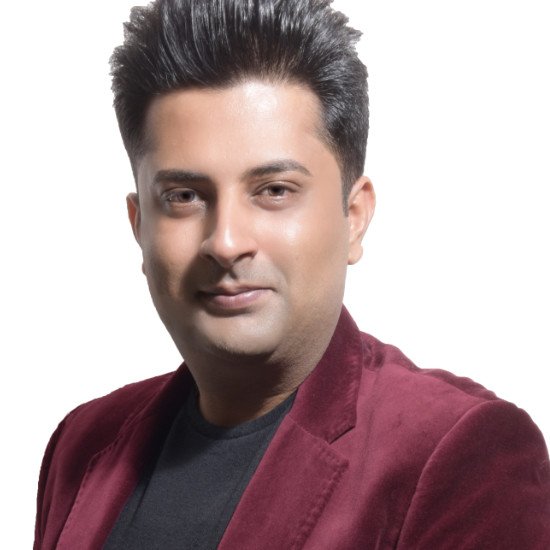
Brother Sumeet Tappoo is Fiji-born, Australia-educated, an MBA from Sydney, and an award-winning Bollywood singer. The Tappoo family has been associated with the Sai movement for many years. As early as 1999, Bhagawan Baba had shown Muddenahalli in a vision to Brother Sumeet, who describes himself as having been blessed with a degree of extra-sensory perception. In that vision, Bhagawan indicated that a great Sai mission was in the offing and declared that he would continue the mission from Muddenahalli after his time in the physical.
Over Guru Purnima 2026, Brother Sumeet recalled seeing “a massive city” in that vision, which he later recognised as Sathya Sai Grama when he visited it in person. Today’s Sathya Sai Grama, he commented, is still only work in progress. In his words, it may one day be regarded as the headquarters of the world.
The visions seemed prophetic to him. Today, Brother Sumeet chairs the Sri Sathya Sai Sanjeevani Hospital in Fiji, inaugurated in 2022. This tertiary-care heart hospital of the One World One Family mission serves all 16 islands of the South Pacific, without a billing section.
Through Sanjeevani Fiji, nearly 500 young lives have been saved through free heart surgeries, in a region where treatment in Australia or New Zealand is unaffordable for many Pacific islanders. More than 50,000 echocardiograms and nearly 80,000 outpatient consultations have reportedly taken place, all free for beneficiaries.
Brother Sumeet, a Director of Fiji’s Sai Prema Foundation, has also been honoured with the Fiji Presidential Medal and The Companion of the Order of Fiji.
In 2008, when Bhagawan Baba publicly declared that he would soon be travelling the world, Brother Sumeet prayed that he would come to Fiji too. According to him, Bhagawan answered through another vision. He saw Bhagawan in a plane headed for Fiji, with an unknown young man seated beside him. When Brother Sumeet met Madhusudan Naidu for the first time in April 2015, he instantly recognised him as the young man from that vision.
When he received a seven-member contingent, including Bhagawan Baba in subtle form, a few months later, he recognised them too as the same seven whom he had received in Fiji in that earlier vision. Through Madhusudan Naidu, Bhagawan Baba communicated soon after arriving in Fiji in 2015 that there was work to do. A large free heart hospital had to be built in Fiji. Against considerable odds, it happened.
Brother Sumeet, neither a doctor nor an engineer, describes the building of this world-class free heart hospital in remote Fiji, where nearly everything had to be imported, as a 21st-century miracle of Sai. Bhagawan Baba also told him in visions that he would one day accompany Bhagawan on global travels. That too came to pass. Brother Sumeet says he had a ringside view of an extraordinary phenomenon: an invisible Bhagawan Baba manifesting through the person of his young communicator, Brother Madhusudan.
To the rational mind, such accounts may be difficult to absorb. But within the devotional and experiential framework of those who lived them, they form part of the story of how the mission unfolded.
The reluctant Sadguru
Over Guru Purnima 2026, Brother Sumeet recollected landmark incidents etched in his memory.
Once, in 2017, he had been called backstage. He says he was stunned to see Bhagawan Baba in flesh and blood. Bhagawan then told him in Hindi, “From this point, Madhu will take this work forward; lead this mission forward.”
Another devotee who intuitively sensed the spiritual metamorphosis of Madhusudan Naidu into Sadguru Sri Madhusudan Sai was Isaac Tigrett. Tigrett is widely known as the philanthropist who sold his legendary Hard Rock Café chain to help fund Bhagawan Baba’s first super-speciality hospital without a billing section in Puttaparthi.
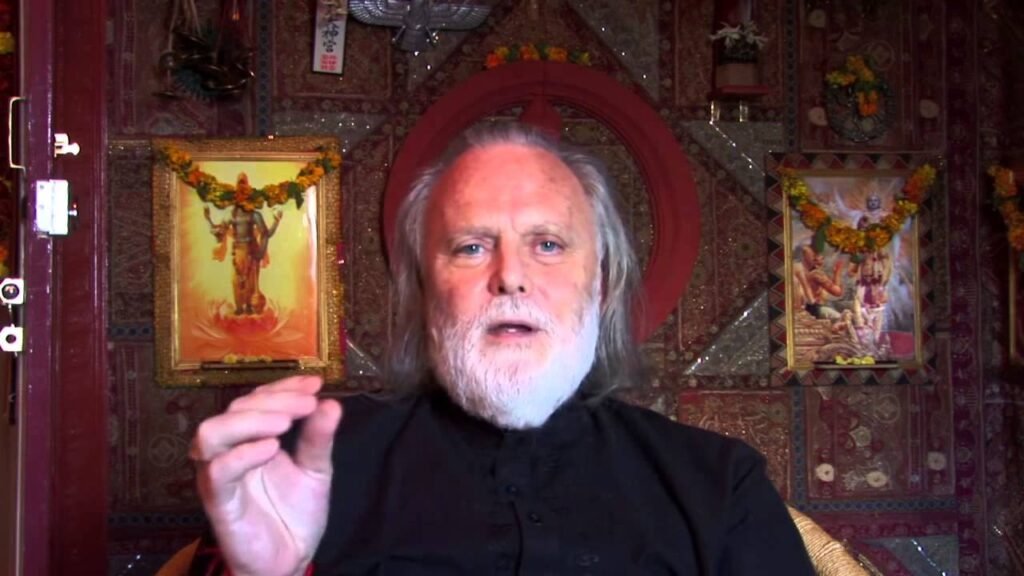
Brother Isaac Tigrett, according to devotees, had also been trained by Bhagawan Baba to realise through direct experience that the real identity of a human being is beyond the physical. For nearly a decade, Baba is said to have manifested in subtle form and taken Tigrett and a yogini, under whom he was apprenticed, on out-of-body journeys. Tigrett, familiar with the idea of existence in the subtle, would often say to Brother Madhusudan: “Soon you will have to sit on that throne.”
Brother Madhusudan, happy to remain a humble servant doing Bhagawan Baba’s bidding, was reportedly dismayed. He was, by several accounts, a reluctant Sadguru in the making.
Bhagawan Baba, however, did not make it easier. Once, in Argentina, a throne made for Bhagawan was brought in for inspection. To Brother Madhusudan’s consternation, Bhagawan ordered him to sit on it and check it out. Brother Madhusudan refused. “Then you will have to sit on the jhoola,” Bhagawan playfully warned. Sitting on a stationary throne seemed the less embarrassing option, and Brother Madhusudan complied.
Brother Sumeet was present. But when he turned to look at Brother Madhusudan, he says he saw not him, but Bhagawan Baba seated on the throne. To Brother Sumeet, the message was clear: the two were one. “Brother, your days of being a communicator are numbered. You will soon be Bhagawan. But please continue to love us as you do now,” an overwhelmed Brother Sumeet is said to have told a dismayed but calm Brother Madhusudan, who by then seemed resigned to fate.
Guru Purnima 2019 marked the transition. In a mystical turn of events, Bhagawan Baba anointed Brother Madhusudan as Sadguru Sri Madhusudan Sai, a Self-Realised Ascended Master. The event was beamed live across the world.
A personal testimony
This scribe was living in Singapore then. Those days, Bhagawan Baba was inwardly guiding me on a book titled The Most Incredible Sathya Sai Mission: Post-Mahasamadhi. On Guru Purnima 2019, between 9 a.m. and 11:30 a.m. Singapore time, Bhagawan spoke inwardly to me about Brother Madhusudan’s ascension. I almost wondered if my imagination was on overdrive.
But at 11:30 a.m. Singapore time, which was 9 a.m. in India, when I switched on the live stream from Sathya Sai Grama, all that Baba had just conveyed began to unfold. To me, it felt as if I had been blessed with a preview of the event.
I remember watching Brother Sumeet on the screen that day. He was called in to escort Brother Madhusudan, who sat with eyes closed, absorbing the momentousness of ascension. Brother Sumeet would later reveal in a talk that when Brother Madhusudan opened his eyes, he was not the Madhusudan Naidu he had known. Something had changed permanently. He was now Sadguru Sri Madhusudan Sai.
Like how a caterpillar metamorphoses into a butterfly, one might ask? Yes, something like that. An irreversible change.
To enable educated but spiritually undertrained 21st-century minds to understand the phenomenon, Bhagawan Baba explained it thus: Madhusudan now had the option to function from three levels of identity – as Madhusudan, as Sathya Sai, or as Supreme Consciousness.
Consciousness and the modern mind
What does science say about all this?
Our bodies are made of atoms, and atoms are largely empty space. What we experience as a solid body is, at one level of physics, far less solid than it appears. Underlying this apparent solidity, many spiritual traditions point to an omnipresent consciousness — a self-aware, supreme intelligence — as our real identity.
Modern science is still debating the nature of consciousness. In physics, the centre of gravity is an indispensable conceptual tool. In the study of life, experience and the cosmos, consciousness may increasingly become a kind of centre of narrative gravity.
Science may not yet have language for omnipotence. But Sadguru Sai explains from direct experience that when one lives from the identity of consciousness, beyond narrow body-mind identities, one feels one with all.
From that oneness arises selfless love. According to Bhagawan Baba, this pure, selfless love is omnipotent. His life was offered as proof of that principle. Sadguru Sai, devotees believe, embodies this same pure selfless love. The global One World One Family mission, in this view, is one material expression of the omnipotence of selfless love.
This gives deeper meaning to Sadguru Sai’s simple statement: “I just learnt to love as my Master did, and Love did the rest.” When a television anchor recently asked him what he considered the highest of all his achievements, his reply was striking: “That I conquered myself; conquered ego and selfishness.” That answer may be the key to understanding him.
Beyond devotion, towards practice
Sadguru Sai’s main mission now is to create more Sadgurus. “If I can do it, so can you,” is his constant refrain. The task entrusted to him by his Master, he says, is to help make more Sai Babas. To educate seekers in this highest knowledge, Sadguru Sai has created an easy-to-understand programme of theory and practice. His talks are available free on YouTube. Listening, contemplating and meditating on them, and then practising them in daily life, becomes sadhana.
The practical side of this sadhana is participation in service projects with selfless love. Such service, the teaching goes, steadily chips away at ego-driven, selfish and negative traits. When selfless love shines through unobstructed, one begins to experience glimpses of a larger possibility. But what good is all this to ordinary people?
For a start, by joining or supporting the mission, people become part of a vast do-good movement. The world becomes a little better, and individuals get an opportunity to become instruments in what may be called a goodness revolution. More importantly, even ordinary people get a chance to loosen their grip on limited, mortal body-mind identities.
We can choose to remain confined to separateness – to name, form, anxiety, fear and mortality. Or we can listen, learn and attempt to live from a wider consciousness identity. This does not require rejecting ordinary life. It may simply mean carrying its problems differently.
Even an intellectual understanding of this truth can make life’s difficulties sit lighter on the shoulders. We begin to see that no matter how terrible they seem, our problems are passing clouds, or storms. In reality, the teaching suggests, we are closer to the untouched sky.
And what a relief that can be.
Why we need to listen
What makes Sadguru Sri Madhusudan Sai worth studying through modern lenses is not only belief, and not only scale. It is the convergence of the two.
Here is a leader who speaks the language of consciousness but builds schools, hospitals, nutrition systems, rural employment models and global centres of human development. Here is a mission that speaks of selfless love but translates it into meals, surgeries, classrooms, music, farmer recognition and livelihood. This is why the phrase Love as Infrastructure matters.
Love, in this context, is not softness. It is not a slogan. It is not merely a private emotion or spiritual abstraction. It is being used as an organising principle.
To feed children.
To educate the marginalised.
To heal without billing.
To recognise farmers as knowledge-holders.
To offer rural youth pathways close to home.
To build values into education.
To help people remember that the human future cannot be built on efficiency alone.
This is also why the mission belongs in a wider Knobles conversation on from human being to being human. The question is not only what human beings can build. It is what kind of human beings we must become in order to build wisely.
What is Sanatana Dharma’s take on this phenomenon?
The analysis by Dr B.N. Narasimha Murthy Sir, a key figure in this mission and regarded by many as a Brahma Rishi of our times, deserves a separate reflection.
So, dear reader, watch this space for Part Two.



4 Responses
Once again you have beautifully and articulately presented our one world one family story. I’m forwarding it on to others. Thank you.
Very nicely articulated.
Madam wonderful article, by studying I came to know many facts about our Satya Sai Grama achievements super madam
Dear Dr Hiramalini Seshadri,
My gratitude knows no end as I read such an amazingly descriptive n beautifully expressed piece about what Sri Madhusudan Sai represents n has achieved through his work for One World, One Family organisation. Thank u so much n always with His Love.